
Antiperspirant was only ever guarding two spots about the size of a coaster. Your back and chest never got the memo.
You put on the deodorant. You put on a second coat of the deodorant, because you’re not an idiot and you looked at the forecast. And by the time you’ve gone from the parking garage to your desk, there’s a wet stripe down your back anyway.
The stuff worked exactly as designed. It just wasn’t designed for that.
Antiperspirant plugs your sweat ducts with aluminum salts, which is a barrier, and a barrier only covers what you put it on. That’s a patch under each arm and nothing else. You can’t coat your entire back in it, and you wouldn’t want to, since sweating across that much skin is the whole system your body uses to keep from cooking.
Buying a stronger stick to solve back sweat runs on the same logic as “one cocktail feels good, so four will feel great.”
There are three kinds of guys in a heat wave: the guy who keeps his jacket on all day so nobody sees the back of his shirt, the guy who buys a fourth stick of antiperspirant, and the guy who has rebuilt his entire closet around the problem and will never bring it up. The third guy has it right. The underarm is a sealing problem and a barrier can win it. The back and the chest are about airflow and what the cloth does once it’s wet.
That’s a closet problem.
Stop Wearing the Color That Gives You Away

Gray shows sweat worse than anything else you own, and the other midtones are right behind it.
Midtone is just the worst possible place to be. Light enough to darken the second it gets damp, not dark enough to hide it once it has.
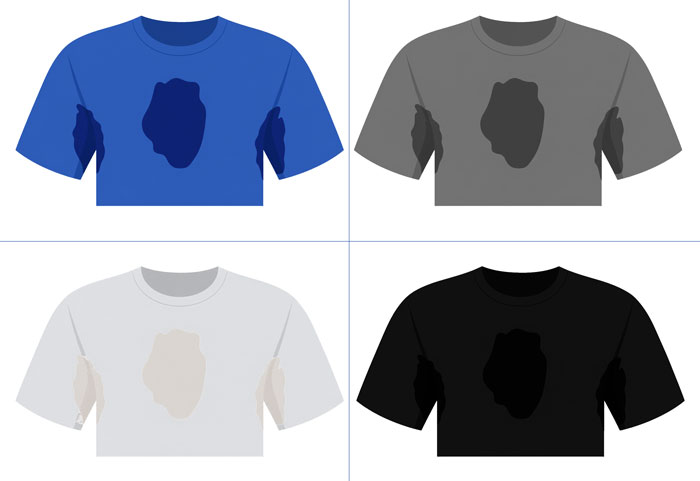
I’ve had the same gray crewneck tee for something like six years, I love it, and it has sold me out in three separate parking lots.
The joke is that gray is the exact color we tell you to buy for an undershirt, because under a white dress shirt it basically disappears. Same gray, one layer apart, completely opposite result. Pale blue is close behind it.
White does dodge the darkening, and then it pulls the other trick you’ve probably watched happen to yourself in a men’s room mirror. Soak it and it goes sheer and clings. Congratulations, you’ve traded a dark patch for a transparent one.

Color only buys you time until the fabric takes over, which is why a heavy white oxford hides a lot and a thin white tee puts on a show. Black and navy are the steadier bet in a plain fabric, with two catches: they run hot in direct sun, and once they dry they can leave a pale salt ring by evening.
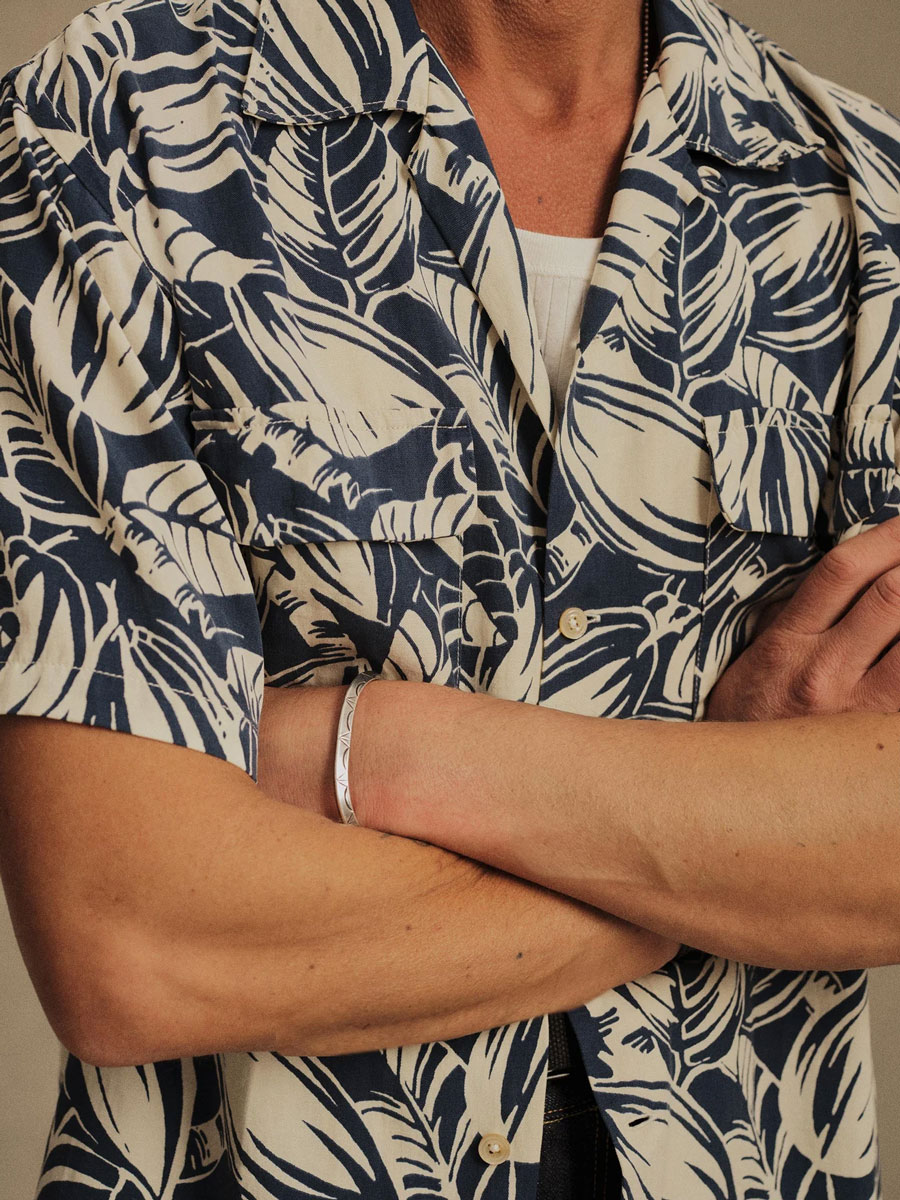
And then there’s the pattern. A stripe, a gingham check, one of those organic prints that don’t look like anything in particular, all of it breaks up the eye so a damp spot reads as part of the design.
Color is your last line of defense though, not your first.
The Undershirt You Gave Up On
On the hottest day of the year the instinct is to take layers off. It’s hot, more shirt means more sweat, seems obvious.
It’s also backwards.
A thin undershirt catches sweat before it reaches the shirt everyone can see, and it spreads it out wide enough to actually evaporate. Skip it and you’re routing the whole thing straight to the layer on display. Preston Schlueter of Gentleman’s Gazette, who has hyperhidrosis (the medical version of sweating a lot, not the ran-for-the-train version), puts it about as plainly as it can be put: “I would prefer that the majority of that sweat be on my undershirt than on my outer layers.”
Which undershirt matters as much as whether. A thick ribbed cotton tee is a sponge, and a sponge honestly works for a while: it soaks up everything before your shirt sees any of it. The problem is when the sponge fills. Saturated cotton stops evaporating, sits wet and warm against you, and passes sweat to the next layer anywhere they touch. The old cotton undershirt buys you the first hour, then spends the rest of the day working against you.

A thin technical knit like Uniqlo’s AIRism moves sweat instead of sitting there holding it. Get the deep V so it stays out of sight under an open collar, because nothing announces an undershirt like a crew neck peeking out of an unbuttoned shirt. A multi-pack is cheap, and it will do exactly nothing for odor by hour ten.
A featherweight merino around 150gsm does more. Gsm is grams per square meter, which is just fabric-speak for how heavy the knit is, and 150 is very light. It surprisingly rarely goes clammy and it can go days without smelling, since sweat is odorless until the bacteria arrive and merino is unwelcoming to bacteria. It costs several times what the synthetic does and you will eventually put a hole in it. Honestly, still worth it.
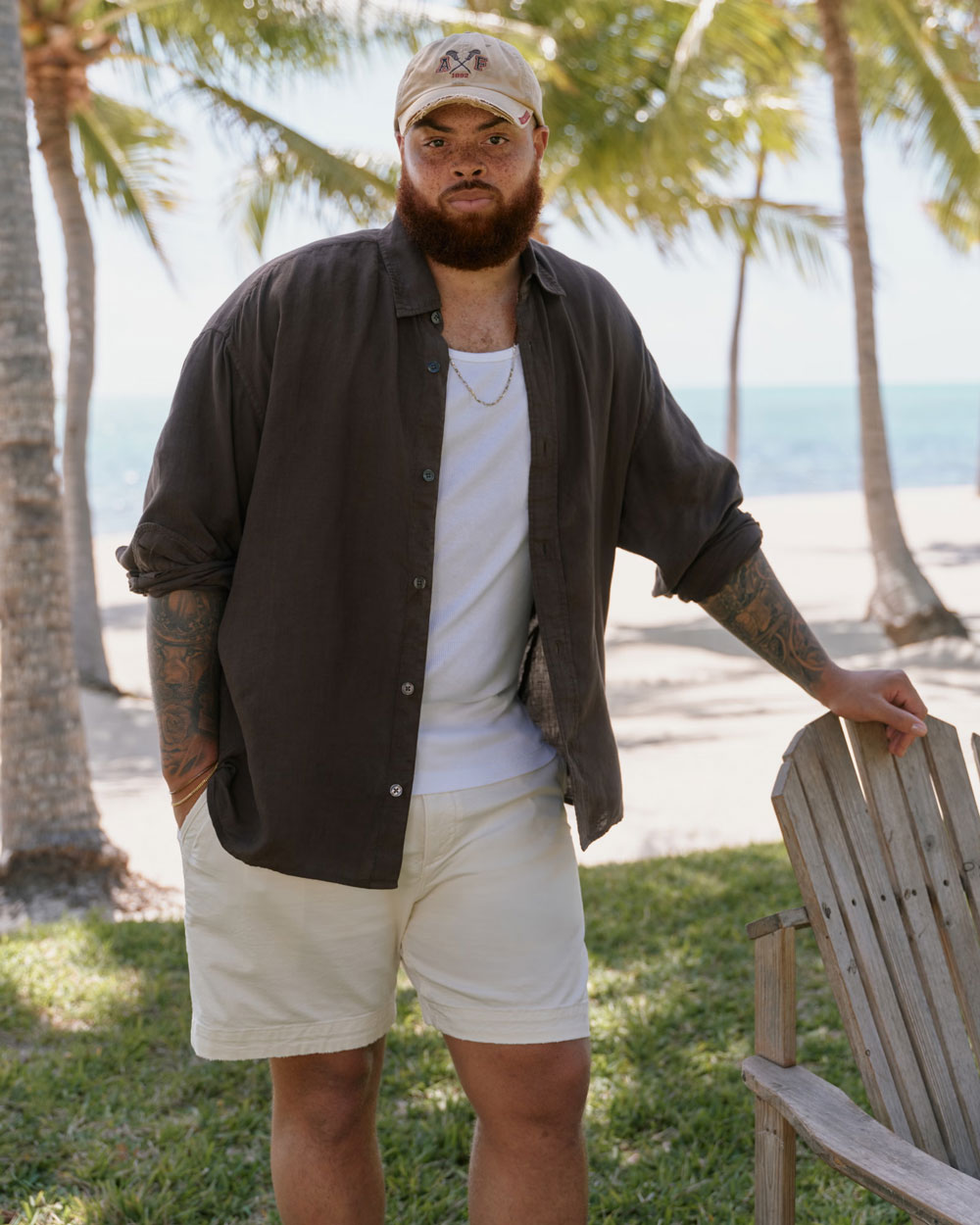
If your problem is back and chest and not armpits at all, a loose tank in normal t-shirt material does the same job. Not the traditional waffley A-shirt your grandfather bought in three-packs, a plain soft one. Under a loose button-up it can actually contribute to the outfit instead of hiding under it.
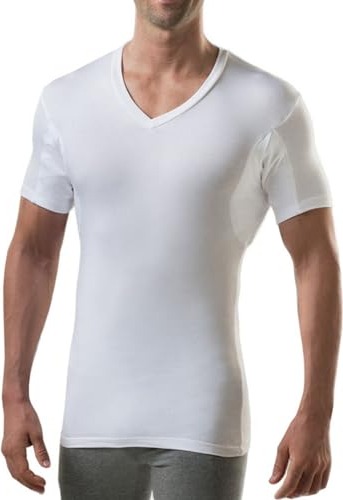
Thompson Tee Sweatproof Undershirt, $44.50
And if that still isn’t enough, there’s a whole category of sweat-proof undershirts with sealed pads at the underarm. Thompson Tee is the one people mean. They work, at the underarm, precisely where they claim to. They also run warm and read a little clinical, so I’d treat one as a last resort and not a starting point.
Change the Fabric Before you Change Anything Else
If you fix one thing on this list, fix this one.
Cotton feels like the breathable choice but in a real heat wave it turns on you. As our guide to linen gets into, once cotton is wet it stays wet, holding all of that against you for hours.
Linen does the opposite. The fibers are hollow, so they wick and shed, and linen takes on close to a fifth of its own weight before it even feels damp to you.
But fiber is only half of it. The half people miss is the weave.
A flat, smooth cloth lies against your skin and shows every wet contour on you. A textured or open weave holds itself off your body, so air gets through and a damp spot never pulls together into one solid mark.
So what has that going on?
Seersucker, oxford cloth, the slubby linens, and hemp or a hemp-cotton blend, which breathes about like linen and creases a little less. It’s the same principle as that ribbed cotton undershirt from the last section, just working in your favor for once.
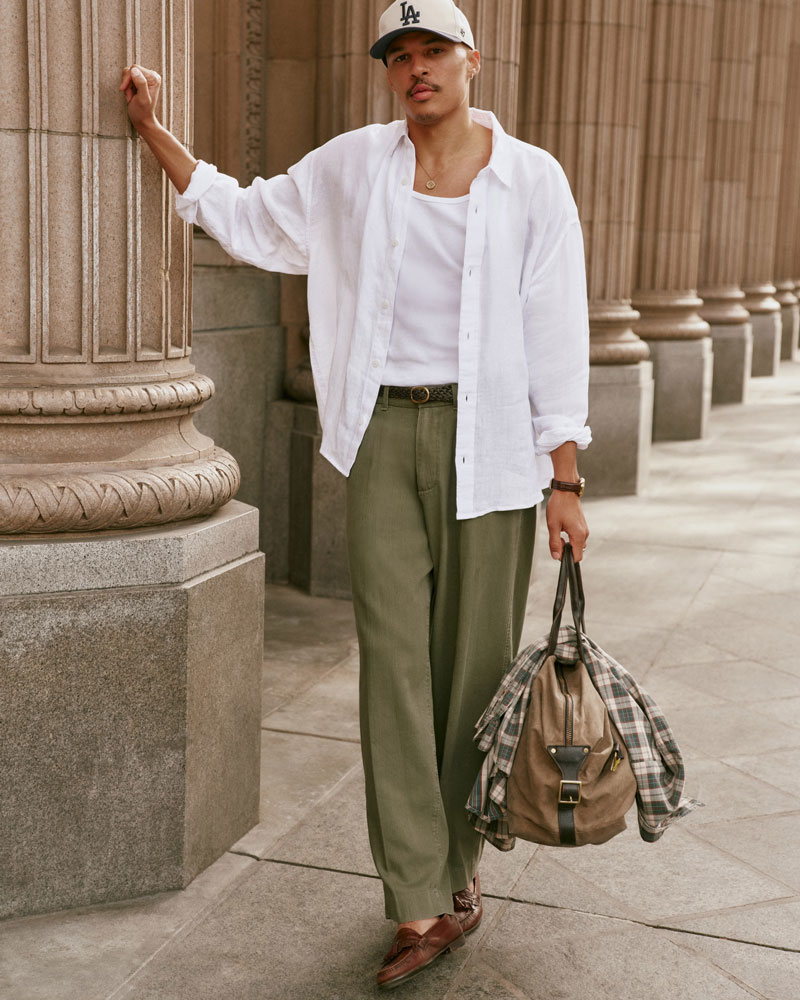
The honest tradeoff is that linen creases if you look directly at it, and I wear it anyway. My laundry system is still a chair, so I made my peace with wrinkles a long time ago.
Not all of it is worth buying, which is a separate argument. Of the ones I actually reach for, Quince and J.Crew on sale are the price play, Huckberry and Buck Mason are where you go for the one that’s still in rotation in five years, and Uniqlo is where to find out whether you even like wearing linen before you spend real money on it.
One honest thing before you go. None of this stops sweat the way an antiperspirant stops sweat, and most articles on this won’t tell you that. These three catch it, move it, dry it faster, or cover for it, which on a normal August Tuesday is the entire ballgame. If you sweat well past the people around you, past what any shirt is going to hide, that’s a real condition with a real name and there are medical routes for it that no linen shirt is going to pretend to replace.
I’ve been dressing around this for years, and the color rule by itself has saved me more shirts than everything else combined.
→ See the whole idea on one outfit:
What’s your move on the hottest day of the year? Chat with me in the comments!


